Human signal
How the day feels.
Short, optional reflections can help a team notice patterns in strain, recovery, pace, and breathing room without turning people into performance metrics.
Veterinary teams already know when the day feels wrong. PulseCheck gives that feeling context — combining human, environmental, and operational signals so the team can see where strain is building before the answer becomes “just push through it.”
A pattern worth looking at. Not a verdict about the team.
Revenue, appointment counts, reminders, call volume, and chart completion all tell part of the story. They do not tell you what the environment is asking of the humans carrying the day.
PulseCheck exists to make that missing layer visible without turning well-being into another productivity score.
Short, optional reflections can help a team notice patterns in strain, recovery, pace, and breathing room without turning people into performance metrics.
Sound, temperature, movement, and other environmental inputs can reveal pressure that software alone cannot see.
Workload, flow, waiting, chart age, handoffs, after-hours activity, and other operational signals can show where friction keeps reappearing.
A quiet signal layer beneath the interface. Not another alert drawer. Not a flashing dashboard. Just enough peripheral awareness to help the team sense what is changing around them.
Strong visual escalation should be reserved for conditions that truly need it.
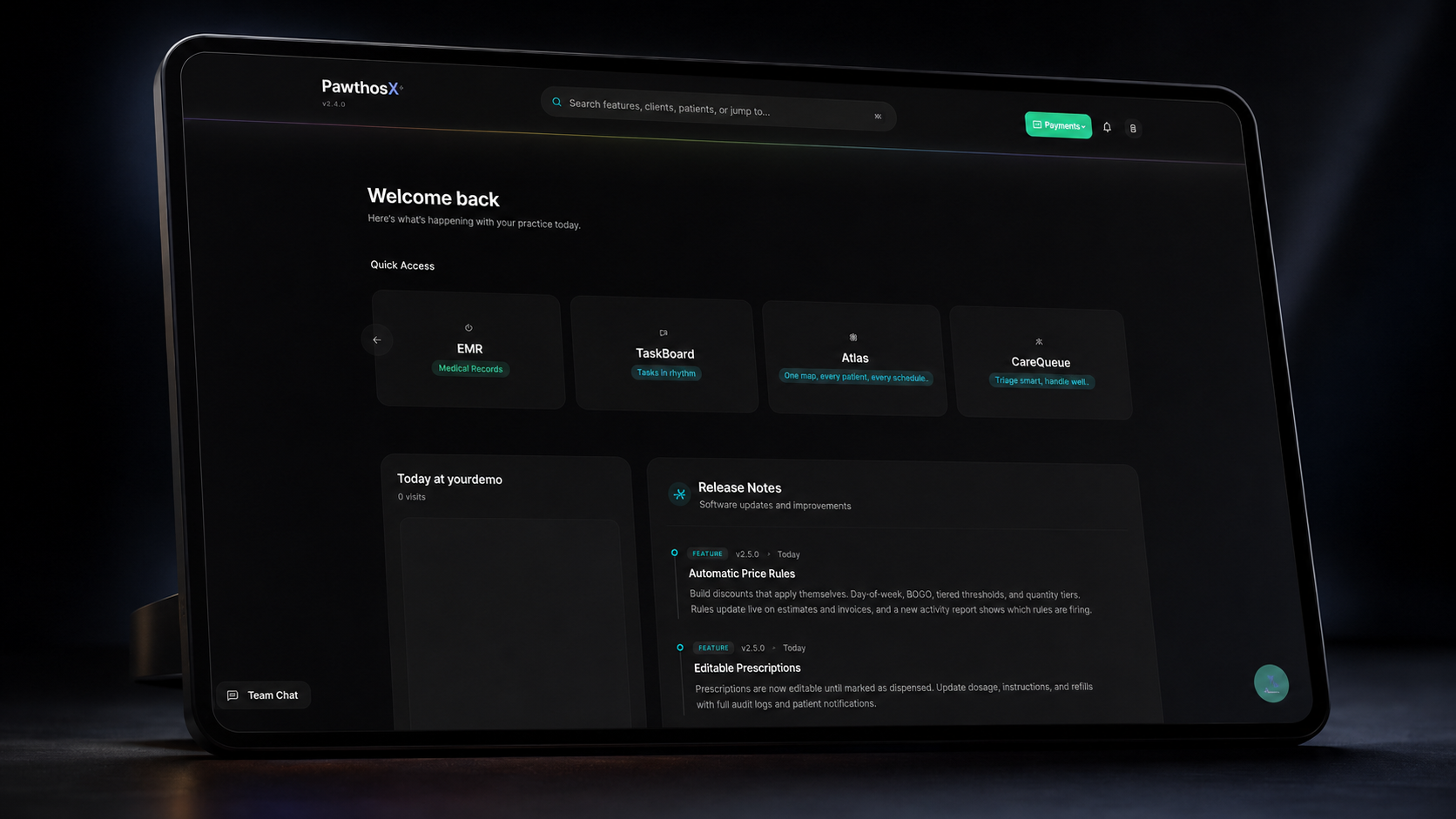
The long-term idea is simple: give teams and leaders a way to see stability over time without turning emotional or operational strain into public comparison.
Not public. Not punitive. Not a performance ranking.
PulseCheck is designed to work most deeply with PawthosX One because the operating context is already there. But the idea is larger than one software system. Compatible vendors and data sources should be able to participate through open integrations.
PulseCheck is a PawthosX Labs initiative designed to help veterinary teams understand human, environmental, and operational pressure inside the practice. It combines optional team reflections, environmental inputs, and workflow signals to make invisible strain easier to see and discuss.
PulseCheck is designed around team-level awareness rather than individual surveillance. Human reflections are intended to surface collective patterns, and environmental or operational signals are used to understand pressure in the clinic rather than judge a specific person.
BridgeLight is an ambient awareness layer that communicates important clinic conditions without relying on a dense alert drawer or another dashboard. It is designed to make pressure and movement visible at a glance while keeping interruptions low.
The Calm Index is PulseCheck's framework for combining human, environmental, and operational stability into a longitudinal view of how the practice is functioning. It is intended as a mirror for teams and leaders, not a public ranking or punitive score.
No. PulseCheck is designed to surface patterns and support discussion. Recommendations or suggested interventions still require human judgment, and clinical, employment, and management decisions remain with the people responsible for them.
PulseCheck is designed to work most deeply with PawthosX One, but the initiative is intended to support broader veterinary software environments through open integrations and compatible data sources.
PulseCheck is an attempt to make that principle measurable enough to act on.