Human rhythm
Optional reflections help the team notice how pressure and recovery change across the week.
PulseCheck is not trying to produce one magical number that explains a team. It is trying to make pressure, recovery, and recurring friction visible enough for people to respond with better judgment.
Optional reflections help the team notice how pressure and recovery change across the week.
Connected sensors can add context like sound, temperature, movement, and room conditions.
Workflow data adds context around waits, workload, after-hours work, chart age, and repeated friction.
The layers come together into a longitudinal view of stability rather than a public score.
The daily view can show where the practice feels stable and where pressure is clustering. The point is not to reward a “good” score. The point is to give the team somewhere useful to look.

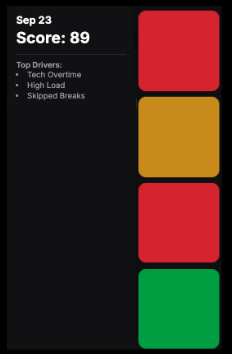
When the overall picture changes, PulseCheck should help the team see what may be contributing: overtime, skipped breaks, workload spikes, chart age, noise, waiting pressure, or other signals available in the clinic.
These are patterns to investigate, not automatic causal conclusions.
PulseCheck gathers the signal layers that are available in the clinic: human reflections, environmental context, and operational workflow data.
The system looks for relationships across time instead of treating each signal as an isolated event.
Patterns can become possible interventions: protect a break, rebalance check-ins, create a reset buffer, or look more closely at a recurring bottleneck.
The clinic can see whether the change helped and build a clearer picture of what stability actually looks like for that team.

A possible intervention might be to protect breaks, smooth check-in pressure, adjust room rotations, or create a short reset buffer. PulseCheck should make the reason visible enough for a person to decide whether the recommendation makes sense.
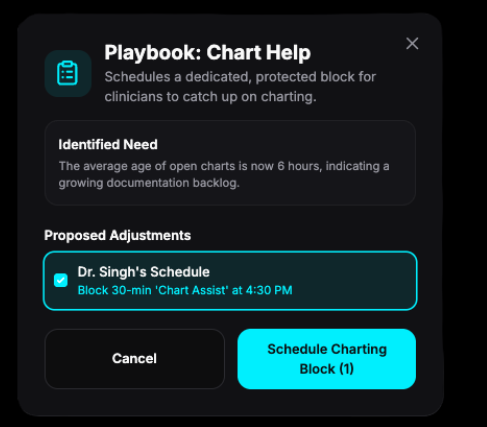
When PulseCheck is connected directly to PawthosX One, it can work with richer operational context because scheduling, documentation, communication, workflow, and follow-up already live in the same operating environment.
Compatible vendors and clinics should still be able to participate through approved integrations, exports, APIs, and other available data sources.
Explore the integration pathThe long-term ambition is to create a useful shared language for stability and recovery in veterinary medicine. That does not require public clinic rankings, punitive employee scoring, or pretending well-being can be reduced to one number.
PulseCheck is designed around three signal families: human reflections, environmental context, and operational workflow data. The exact inputs available depend on the clinic's configuration and connected systems.
PulseCheck looks for patterns across available signals and can surface possible relationships, such as repeated late-day backlog, environmental pressure, skipped breaks, or prolonged chart work. Suggestions are intended to support human review rather than automate management decisions.
No. PulseCheck and the Calm Index are intended as internal tools for reflection and operational understanding, not public rankings of teams or clinics.
The initiative is intended to support compatible external systems through integrations, exports, APIs, and other approved data sources. The deepest workflow context is available when PulseCheck is connected directly to PawthosX One.